Separate supply from output
Identify the voltage that powers the receiver and the circuit its outputs will control. Confirm whether the selected output is a dry contact or supplies a voltage; these arrangements require different wiring.
 ANRIVERSRF CONTROL
PRODUCT CATEGORY
Wireless receivers and switches for lighting, pumps and motor-control projects. Compare the supply, output arrangement and control behavior before matching a receiver to your load.
View all productsHow to choose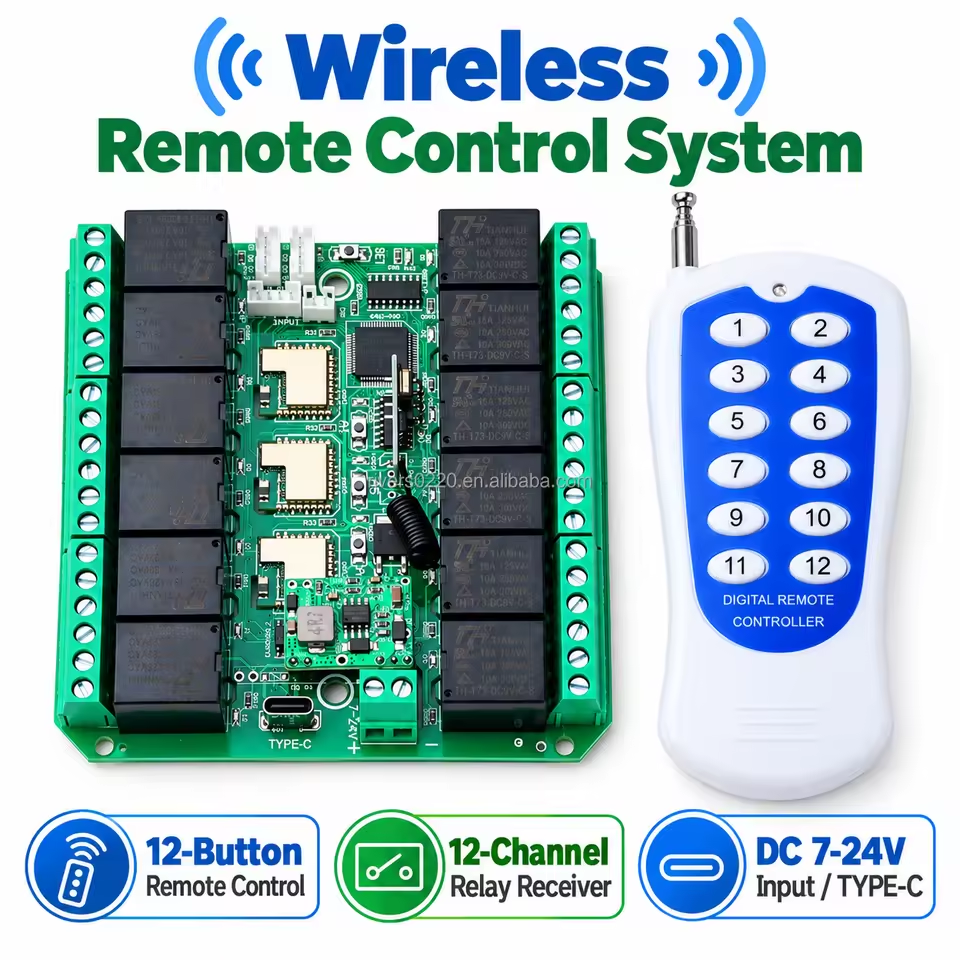
Twelve-channel relay control board combining eWeLink WiFi app access, 433MHz wireless reception and wired digital inputs. Supports DC 7–24V power, a Type-C power connection and selectable momentary, self-locking and toggle operation.
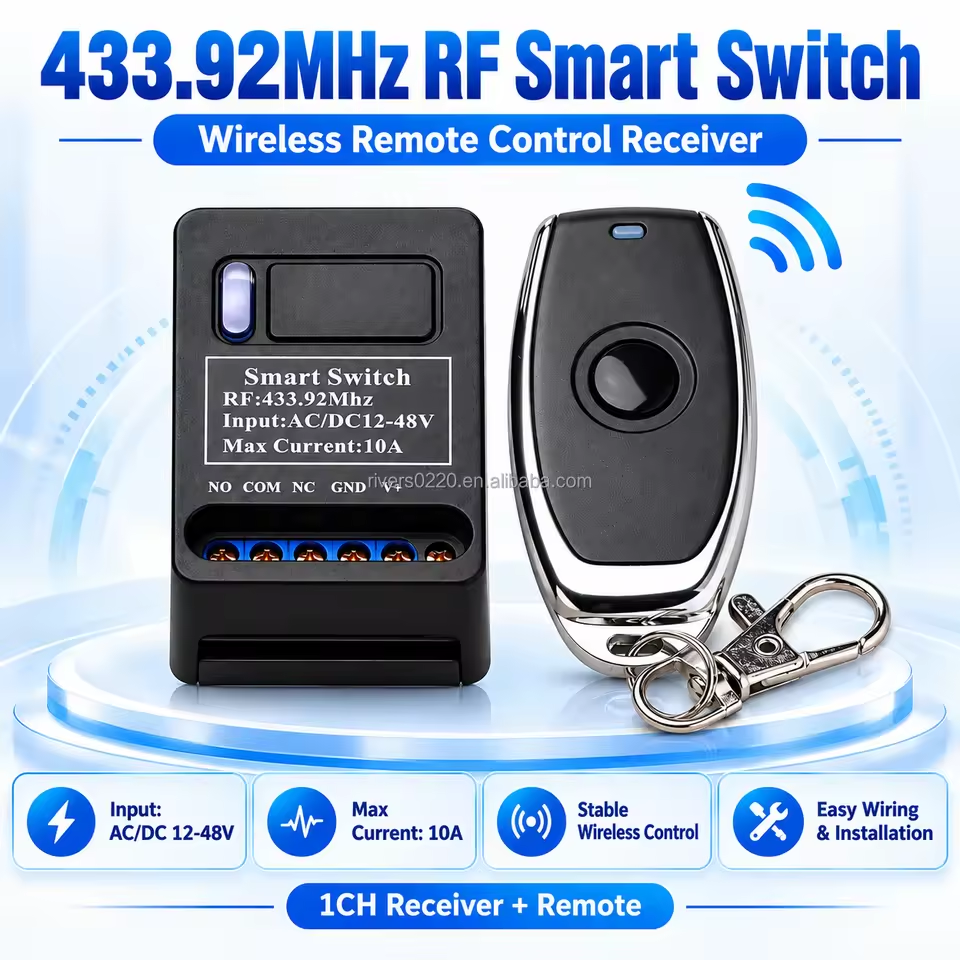
Compact key fob remote paired with an RH1 single-channel 10A relay receiver. Features 433.92MHz learning-code control, AC/DC 12–48V receiver power and NO/COM/NC contacts. Single-button and two-button key fobs are illustrated; specify the required version.
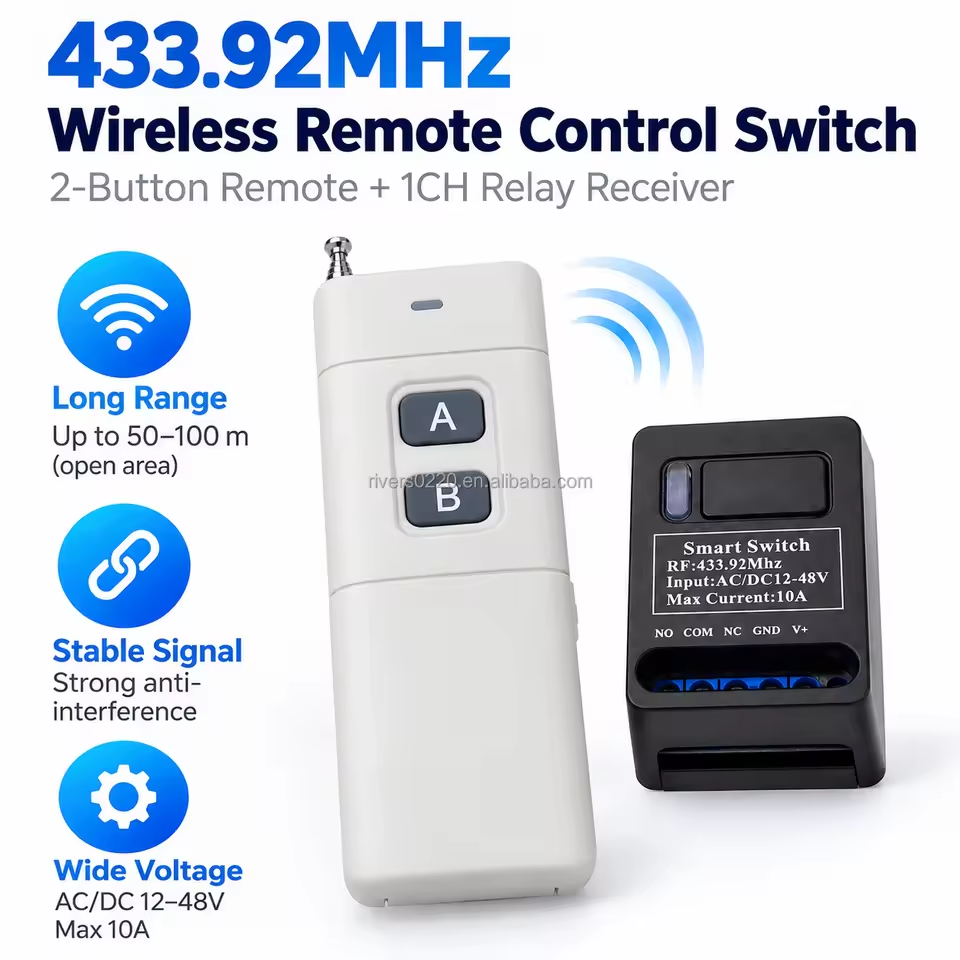
A two-button handheld remote and single-channel 10A relay receiver for local wireless switching. The RH1 & R21 kit operates at 433.92MHz with AC/DC 12–48V receiver power, learning-code pairing and NO/COM/NC relay contacts.
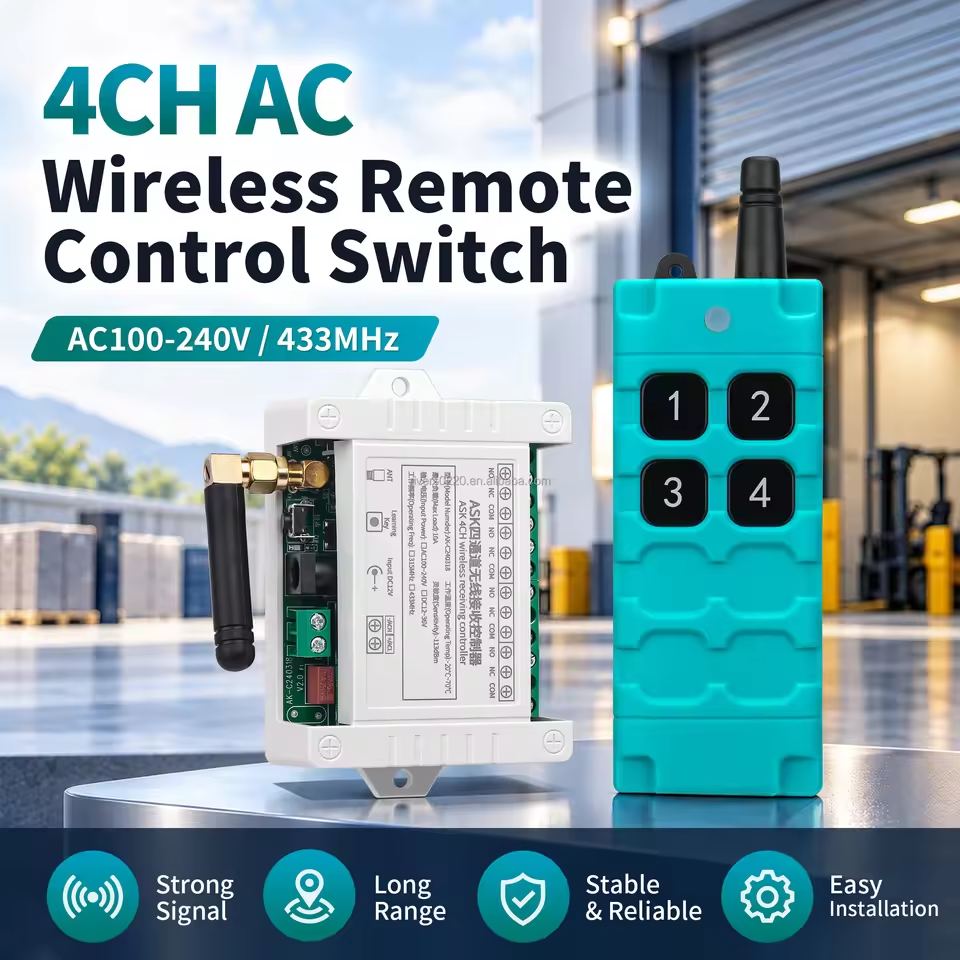
Four-channel 433MHz ASK wireless relay kit with a four-button handheld transmitter for irrigation pumps, solenoid valves, lighting and equipment control. Choose an AC100–240V or DC12–36V receiver version to suit the installation.
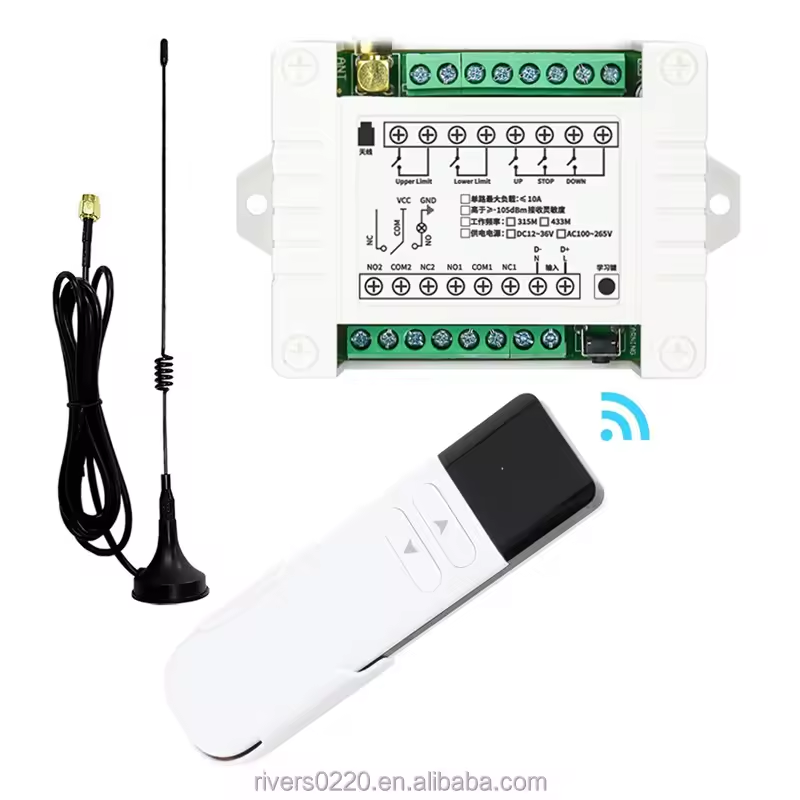
DC 12–36V two-channel wireless motor control kit with a white DL02 remote, upper and lower limit inputs, wired UP/STOP/DOWN control and an external antenna. Available in 315MHz or 433MHz versions.
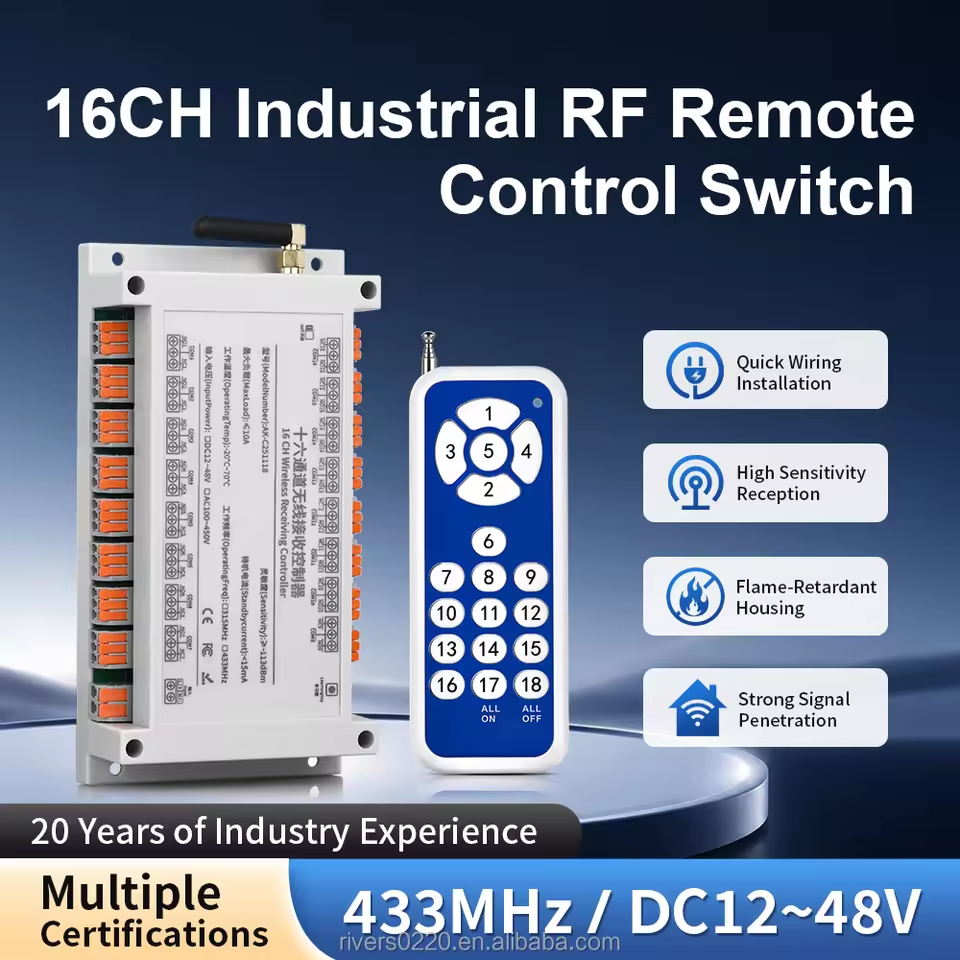
16-channel 433MHz RF remote control and relay receiver for independent switching of up to 16 outputs, with All ON/OFF controls. Available in DC 12–48V and AC 100–450V variants.
SELECTION GUIDE
The useful distinction is what happens after a command arrives. A relay receiver may switch a separate circuit, while a dedicated motor controller may provide a different output arrangement. Establish the wiring and operating sequence before comparing channel counts or headline current ratings.
Identify the voltage that powers the receiver and the circuit its outputs will control. Confirm whether the selected output is a dry contact or supplies a voltage; these arrangements require different wiring.
Provide the load type, rated current and available starting-current information. A relay’s nominal current rating alone does not establish suitability for a motor or pump. Ask whether an external contactor or motor controller is needed.
State whether an output should follow a held button, toggle on each press or release when another channel operates. For motion, specify direction interlocking, limits and the required response after power or signal loss.
PRODUCT COMPARISON
Use the listed specifications to shortlist a starting point. Open the product page for the full configuration and confirm any unlisted requirement with us.
| Product / model | Supply | Channels | Control / output |
|---|---|---|---|
| 12-Channel eWeLink WiFi & 433MHz Relay Controller with Digital Inputs | Confirm with us | Relay channels: 12 | Confirm with us |
| RH1 & R16 433.92MHz Key Fob Wireless Relay KitRH1 & R16 | Confirm with us | Relay channels: 1 | Confirm with us |
| RH1 & R21 433.92MHz Single-Channel Wireless Relay KitRH1 & R21 | Confirm with us | Relay channels: 1 | Confirm with us |
| RK318 4-Channel 433MHz Wireless Relay Control KitRK318 | Receiver supply options: AC 100–240V or DC 12–36V (separate versions) | Relay channels: 4 | Relay rating: 10A, subject to load type |
| R083 & DL02 Wireless Motor Control Kit with Limit InputsR083 & DL02 | Receiver Supply Voltage: DC 12–36V | Relay Channels: 2 | Confirm with us |
| RK118DC 16-Channel 433MHz RF Remote Control SwitchRK118DC | Confirm with us | Channels: 16 independently controlled relay channels | Relay rating: 10 A (supplier graphic; confirm load type before installation) |
APPLICATION FIT
Lighting projects need a clear switching sequence and a load check. Pump panels need a defined interface to the starter or contactor. Motor projects need confirmation of the drive arrangement, direction control and limit inputs. Use the product documentation to establish which functions the chosen model provides.
Explore RF control applications ↗OEM & CUSTOMIZATION
Bring a wiring sketch and a short sequence of operation. We can review supply options, channel assignments, matching transmitters and labeling against the chosen hardware. Approve the wiring and output behavior on a sample before integrating it into the final equipment.
See our customization capabilities ↗BEFORE YOU SPECIFY
Not by itself. Suitability depends on the load, starting current and contact rating for that duty. Provide the motor details and have the switching arrangement checked; the receiver may need to command a separate contactor.
Momentary operation generally follows a button being held; toggle operation changes state on successive commands. Exact timing and signal-loss behavior depend on the receiver. Confirm the selected mode on the actual sample.
Do not treat an ordinary relay receiver as a safety-rated emergency-stop system. Define the equipment’s safety functions separately and confirm the selected control hardware is appropriate for its intended role.
COMPLETE THE SYSTEM
TECHNICAL READING
LET’S SPECIFY YOUR SYSTEM
A clear starting brief makes the first configuration easier to review.