
Short answer: one-way RF control is enough when the command is low-risk, the operator can immediately see the result, and a missed packet causes no dangerous state. If the operator cannot see the machine, if the action has real consequences, or if “command received” must be proved, add feedback—but be precise about what that feedback confirms.
I have seen this misunderstood on otherwise well-built systems. The transmitter LED flashes, so everyone assumes the receiver must have heard the command. It did not. Or the receiver acknowledges the packet, but the motor contactor never pulls in. Both systems have “feedback,” yet neither tells the operator what they actually need to know.
First, define what “received” means
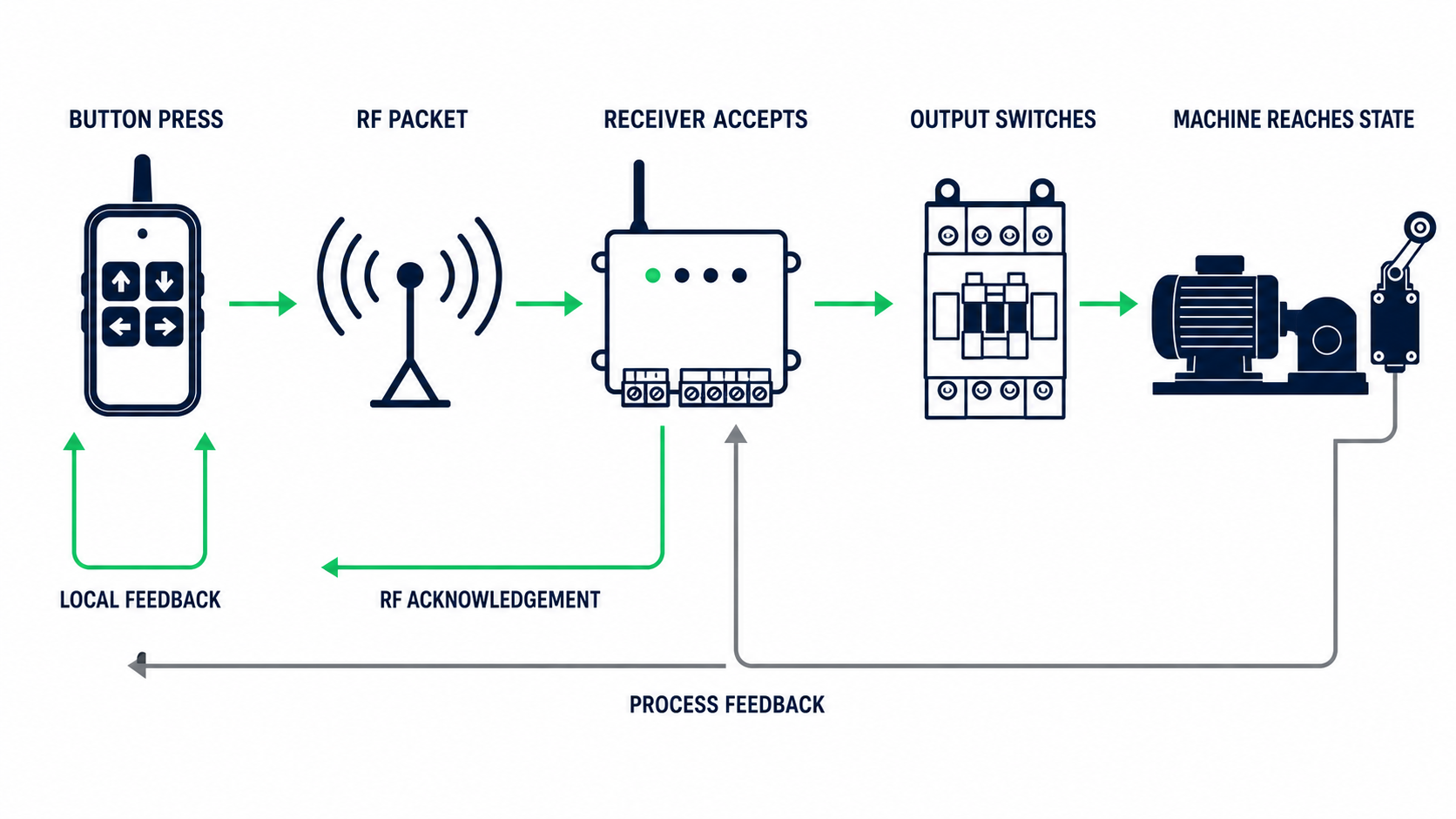
There are at least four different events between a button press and a machine action:
The transmitter detects the button press.
The radio packet leaves the transmitter.
The receiver accepts and decodes the packet.
The controlled equipment reaches the requested state.
A small LED on the handheld unit usually confirms only the first event, sometimes the second. It does not prove that the receiver heard anything. A radio acknowledgement can prove the third event. Only a limit switch, current sensor, auxiliary contact, position encoder, pressure switch, or similar field signal can prove the fourth.
This distinction matters because each failure requires a different fix. A stronger antenna will not repair a welded contactor. A receiver acknowledgement will not detect a broken coupling. Good system design starts by deciding which event the operator genuinely needs confirmed.
When one-way RF is the sensible choice
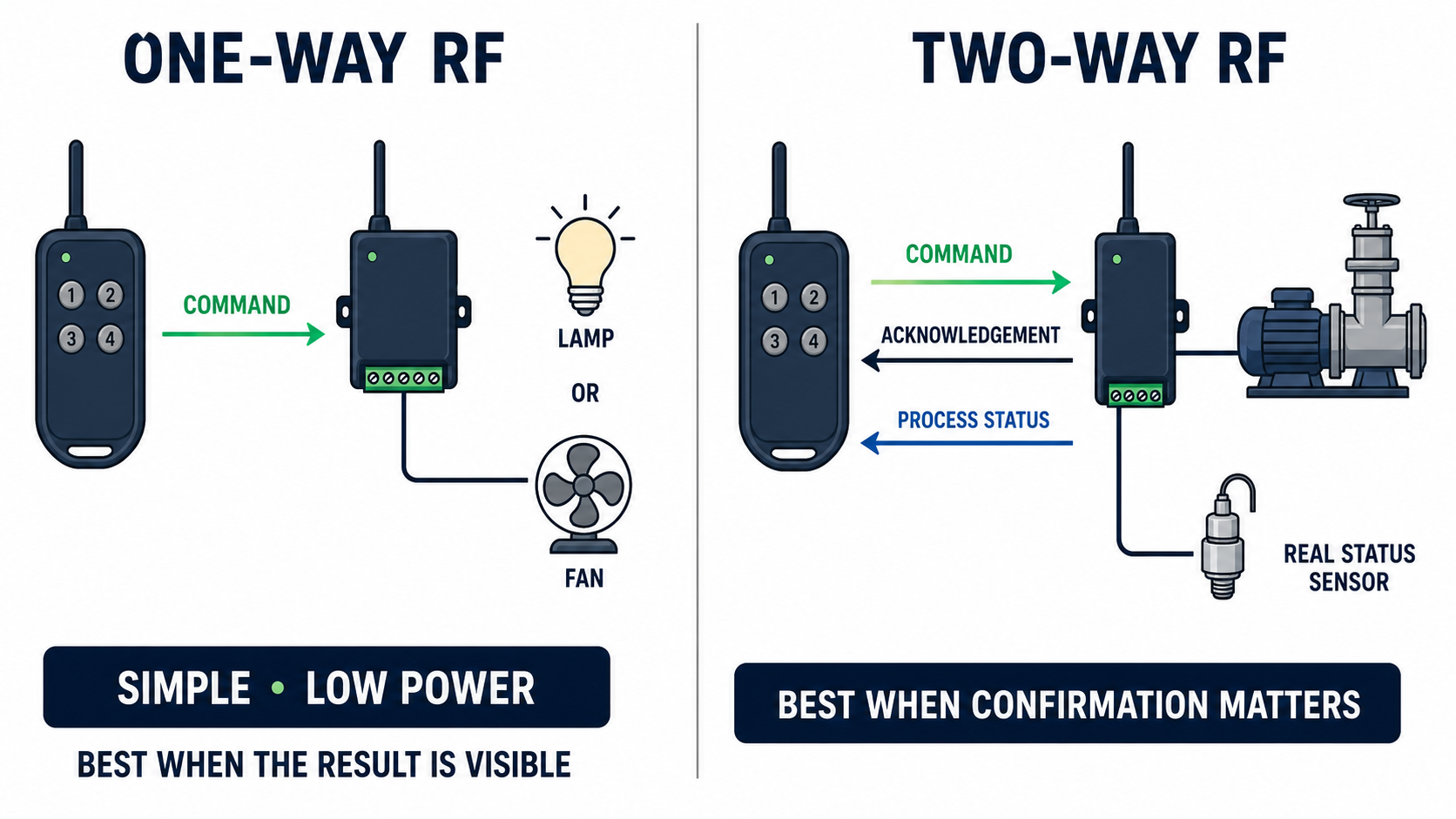
One-way systems are common for good reasons. They are simpler, usually lower in cost, and the transmitter can spend most of its life asleep. That is useful for small battery-powered remotes that may sit unused for months.
I am comfortable specifying one-way control when all of the following are true:
The operator has a clear view or direct audible indication of the result.
A missed command is inconvenient, not hazardous.
Repeating the command cannot create an unsafe or ambiguous condition.
The receiver has a defined fail-safe state after signal loss or power interruption.
The site has been tested in the installed condition, not only across an open workshop.
A gate light, a simple lamp, a nearby fan, or a non-critical auxiliary function often fits this pattern. If the user presses ON and can see the lamp illuminate, the load itself is the feedback. Adding a return radio channel may improve the specification sheet without improving the actual user experience.
The warning sign: operators press the button twice
One of the best field clues is not an RF measurement. It is operator behavior. If users routinely press and hold, press twice, or walk a few steps and try again, they do not trust the system state.
That second press can be harmless on a momentary output. On a toggle output it may undo the first command. On a latching or sequence-based machine it can cause a second movement the operator did not intend. The problem is no longer just radio range; it is an uncertain human-machine interface.
Before changing hardware, check whether the remote gives a clear local indication that the button was accepted, whether the receiver output mode matches the application, and whether the machine response is fast enough to be recognized. A 300 ms delay can feel much longer when the user has no visible feedback.
Three useful levels of feedback
1. Local confirmation
A click, buzzer, vibration, or transmitter LED tells the operator that the handheld electronics registered the button. It is inexpensive and useful, but it is not a radio acknowledgement. Treat it as interface feedback only.
2. Receiver acknowledgement
In a bidirectional link, the receiver sends a return message after it validates the command. The remote may then change an LED from amber to green, vibrate, or display a status icon. This confirms that the radio path worked in both directions and that the receiver logic accepted the packet.
For a robust implementation, the acknowledgement should belong to a specific command and transaction number. A generic “I am alive” packet can arrive at the wrong moment and be mistaken for confirmation of the latest button press.
3. Process confirmation
This is the highest-value feedback for consequential machinery. The receiver or machine controller reports a real input: gate closed, pump running, brake released, contactor energized, tank level reached, or valve at position.
Process confirmation is slower and requires more wiring and logic, but it answers the question the operator normally cares about: did the equipment actually do it? On critical applications I prefer to label this honestly. “Command accepted” and “movement complete” are not the same message.
Where two-way control earns its cost
Bidirectional RF becomes worthwhile when uncertainty is expensive. Typical cases include:
Equipment operated beyond direct line of sight.
Pumps, valves, conveyors, winches, doors, barriers, and access systems where position or running state matters.
Commands that start a long sequence rather than a brief output pulse.
Sites where multiple machines look or sound similar and the operator must know which unit responded.
Applications that need battery, fault, link-quality, or receiver-power status at the handheld unit.
Controls where repeated operation could reverse, stop, or retrigger the machine.
Emergency-stop functions require a separate safety assessment. A return packet and a green LED do not by themselves make a standard RF link safety-rated. If the radio participates in a safety function, the complete system—architecture, diagnostics, fault response, components, and applicable standards—must be designed for that purpose.
Do not let acknowledgement hide a weak link
Two-way communication is not a substitute for good RF installation. In fact, the return path can be weaker than the command path. The receiver may have a good external antenna and plenty of supply power, while the handheld transmitter has a small internal antenna close to the operator's body. The command reaches the machine, but the acknowledgement struggles to get back.
Test both directions with the product installed, enclosure closed, machine running, and the operator standing in realistic positions. Include the worst orientation of the handheld unit. Metal cabinets, vehicle bodies, wet concrete, people, and motor noise can change the result substantially.
Set a sensible retry strategy as well. Too few retries produce nuisance failures. Too many make the interface feel slow and can congest a busy channel. In most control systems, the operator should receive a clear timeout indication instead of watching an LED spin indefinitely.
A practical specification checklist
When discussing a new wireless control project, I ask these questions before choosing one-way or two-way hardware:
Can the operator directly see or hear the controlled result?
What happens if one command is missed?
What happens if the same command is sent twice?
Is confirmation needed for packet reception, relay operation, or the final machine state?
How quickly must confirmation return to feel trustworthy?
What should the system display when confirmation times out?
Does the installation require status from several receivers or machines?
What is the required battery life, and how often will the remote listen for replies?
Are there regulatory, functional-safety, or logging requirements?
How will the complete link be tested after installation?
These answers usually make the architecture obvious. They also prevent a common quotation problem: asking for “two-way RF” when the real requirement is a limit-switch input and a clear operator indication.
My rule after ten years of field work
Use the simplest radio link that still gives the operator justified confidence. For a visible, low-consequence load, one-way control is often the right engineering decision. For hidden, delayed, or consequential actions, build a return path and decide exactly what it proves.
The most reliable systems do not merely send commands. They manage uncertainty. When the operator knows whether the command was accepted, whether the equipment moved, and what to do if no confirmation returns, the wireless control feels predictable—and predictable equipment is equipment people trust.